What is Horizon Scanning?
Organizations face nonstop disruption—from regulatory changes and geopolitical instability to cyber threats and shifting market dynamics. Trying to monitor news articles to keep up with threats on your own leaves blind spots that can quickly turn into crises. By the time risks are visible, damage is often already done.
Unknown risks carry staggering financial consequences for businesses. Cybercrime and sabotage drained German firms of $298 billion in a single year, while the average data breach now costs $4.88 million per incident. Insider threats add another $16.2 million annually—often more in North America—and poor data quality contributes an average loss of $12.9 million each year. On top of that, IT downtime can reach anywhere from $8,000 to $700,000 per hour, underscoring how hidden vulnerabilities can quickly escalate into major financial and operational setbacks.
Below, learn what horizon scanning is, the types of risks it identifies, how it works in practice, and the benefits it delivers to your business.
How Does Horizon Scanning Work?
Horizon scanning is the structured process of detecting emerging external risks before they escalate. It continuously monitors and systematically analyzes a wide range of data sources to detect emerging signals. Traditional risk management often focuses on known risks—those already documented in risk registers and mitigated through established controls. Horizon scanning extends this scope by capturing the unknown: signals that point to future threats and opportunities alike.
Modern horizon scanning relies on AI-powered platforms that capture millions of signals in real time, then categorize and prioritize them for decision-makers. A tested horizon scanning model delivers reliable, structured intelligence instead of overwhelming noise. This way, leaders can act with speed and confidence.
Six Types of Risks Horizon Scanning Searches
1. Regulatory and Compliance Risks
One of the most critical applications of horizon scanning in risk management is regulatory change. Laws and regulations are expanding at an unprecedented pace, from AI governance frameworks to environmental, social, and governance (ESG) disclosure mandates. Horizon scanning ensures compliance teams see these developments before they become enforceable obligations.
For example, a company monitoring early signals from European policymakers can prepare for stricter reporting requirements months before they are formally adopted. This proactive stance reduces compliance costs and protects against reputational harm.
2. Cybersecurity Threats
The digital threat landscape evolves daily. Hackers innovate quickly, and vulnerabilities can spread across industries with devastating speed. With effective horizon scanning tools, companies can detect early signs of cyber risk by monitoring threat intelligence reports, technology blogs, and even underground forums where new exploits are discussed.
3. Supply Chain Disruptions
From natural disasters to geopolitical conflicts, supply chains are fragile ecosystems vulnerable to shocks. A robust horizon scanning model helps track indicators like political instability, sanctions, labor strikes, or raw material shortages. A well-prepared organization can reroute sourcing, diversify suppliers, or stockpile inventory in anticipation of disruption. This means avoiding costly downtime.
4. Geopolitical and Macroeconomic Shifts
Global business is increasingly shaped by geopolitical developments. Trade wars, sanctions, and regional conflicts can destabilize markets with little warning. Horizon scanning in risk management contextualizes these developments by continuously monitoring diplomatic relations, international policies, and financial publications.
5. Reputation and Public Sentiment
Reputation is one of a company’s most valuable yet fragile assets. AI-powered horizon scanning tools use sentiment analysis to measure how a brand or industry is being discussed across media and social platforms. Negative narratives, once they gain traction, can impact investor confidence, employee morale, and customer loyalty. By detecting sentiment shifts early, organizations can respond strategically rather than scrambling in the face of a public crisis.
6. Competitive and Market Trends
Horizon scanning is not limited to defensive measures. By monitoring competitors, consumer trends, and industry innovations, organizations can identify gaps, anticipate demand, and enter markets ahead of rivals. When using the best horizon scanning tools, leaders can uncover hidden opportunities that generic monitoring methods miss.
Why Horizon Scanning Matters
Proactive risk management, enabled by horizon scanning, provides the time and clarity needed to prepare. Organizations that practice horizon scanning in risk management:
- Gain an early-warning system that extends beyond their internal data
- Reduce the likelihood of being blindsided by external threats
- Strengthen resilience by preparing contingency strategies in advance
- Align their responses with long-term strategic objectives
When early risk detection supports proactive governance, it’s a win-win.
How Horizon Scanning Technology Benefits Companies
1. Early Risk Detection
By capturing signals before they escalate, horizon scanning provides a longer runway for action. Whether it is a regulation in draft form, a brewing geopolitical conflict, or early chatter about a cyber exploit, early detection means organizations can plan rather than panic.
2. Smarter Decision-Making
The best horizon scanning tools convert unstructured information into structured intelligence. Dashboards, scoring systems, and categorized insights make it easier for executives to understand the severity and likelihood of risks. Instead of relying on intuition or incomplete reports, leaders base decisions on real-time, data-informed insights.
3. Improved Collaboration
Because horizon scanning insights can be integrated into enterprise risk management workflows, different departments share the same intelligence. Compliance, operations, IT, and executive teams work from a unified view of external and internal risks. This drives faster, coordinated responses.
4. Efficiency and Cost Savings
Preparing for risk in advance is almost always less costly than responding after the fact. Horizon scanning tools reduce downtime, help avoid regulatory fines, and minimize reputational damage. They also make internal risk processes more efficient by prioritizing only the most relevant signals.
5. Competitive Advantage
Organizations that see risks sooner can act sooner. By benchmarking risk exposure against peers and monitoring market trends with a tested horizon scanning model, companies can position themselves as industry leaders.
6. Long-Term Resilience
Beyond immediate savings, horizon scanning contributes to long-term organizational resilience. By continuously adapting to external change, companies become less brittle, more agile, and better positioned to thrive in volatile markets.
How Horizon Scanning Works in Practice
Several various steps include:
Continuous Monitoring of Global Sources
Effective horizon scanning involves monitoring millions of data points across media, regulatory bodies, financial publications, and other trusted sources. The best horizon scanning tools specialize in capturing these signals across multiple domains.
Categorization and Scoring
Signals are not useful unless they are contextualized. A strong horizon scanning model categorizes risks—such as cyber, regulatory, supply chain, or geopolitical—and scores them for severity and relevance. Sentiment analysis adds another layer by indicating whether public perception is improving or deteriorating.
Visualization and Dashboards
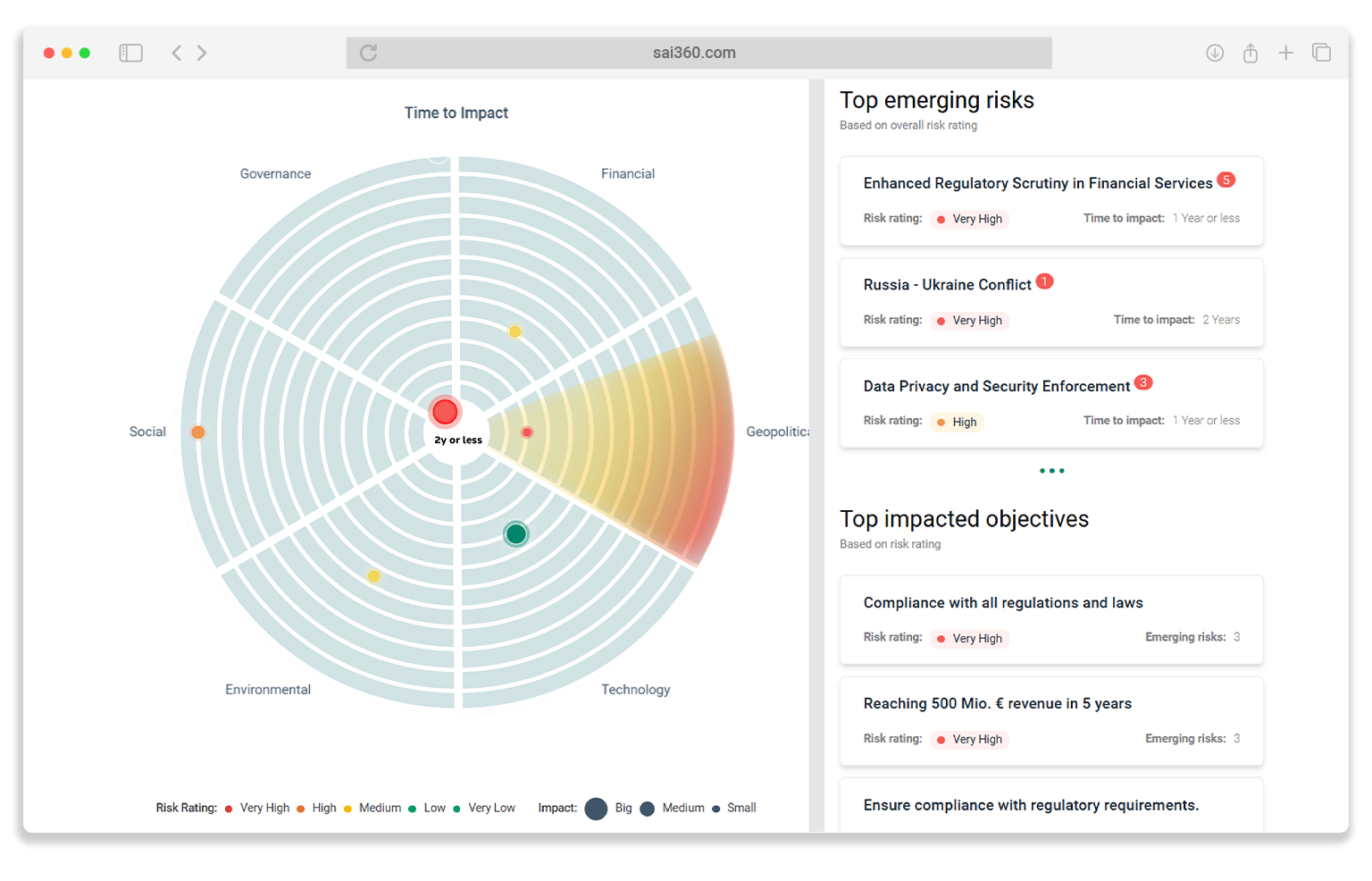
Risks are visualized through interactive dashboards that allow leaders to drill into details, compare metrics, and track changes over time. This unified view combines external signals with internal exposure, giving executives clarity on where the organization stands at any given moment.
Integration with Internal Workflows
The final step is linking external intelligence to internal risk processes. Horizon scanning in risk management ensures that insights feed directly into registers, controls, and mitigation strategies. This eliminates silos and ensures that proactive measures align with existing enterprise frameworks.
What are some Real-World Examples and Scenarios to Know?
These scenarios illustrate the central value of horizon scanning: foresight that buys time, reduces damage, and creates strategic advantages.
- Regulatory foresight: A pharmaceutical company tracks early health agency discussions about gene therapy controls. Months before regulators issue formal rules, it adjusts its R&D plans, saving millions in rework costs.
- Geopolitical risk: By monitoring diplomatic tensions, an aerospace firm diversifies its titanium suppliers before sanctions cut off a key source. Competitors who did not prepare face production delays and rising costs.
- Cybersecurity: A financial services company detects discussions of a new malware strain in technical forums. It strengthens defenses before attackers launch a wave of intrusions.
- Reputation management: A consumer brand spots negative sentiment building around product safety. By launching a transparency campaign, it prevents a minor issue from escalating into a reputational crisis.
Why is Horizon Scanning Indispensable?
The pace of change is not slowing down. Global regulation is expanding, cybercriminals are becoming more sophisticated, and industries are being reshaped by technology and consumer expectations. In this context, horizon scanning is not optional—it is becoming a baseline requirement for responsible governance, risk management, and corporate strategy.
Organizations that embed a tested horizon scanning model into their operations will not only reduce exposure but also harness risk intelligence to fuel innovation and growth. Those that do not will increasingly find themselves reacting to headlines rather than shaping them.
Technology That Powers Horizon Scanning
Horizon scanning today requires technology built for scale. Horizon scanning is more than a monitoring exercise; it is a foundation for resilient, forward-looking governance. Companies that practice it move from reacting to crises toward shaping strategy with foresight.
The advantage lies in both breadth and precision. Rather than presenting unstructured feeds of information, these tools categorize risks, benchmark against competitors, and prioritize the signals that matter most. For risk and compliance leaders, that means less time parsing noise and more time making decisions. Organizations that invest in automated horizon scanning gain foresight at a scale and speed that human teams alone cannot match.
Bringing It All Together
SAI360 is part of a much larger story. Our integrated GRC platform, powered by AI, unifies horizon scanning, risk management, training, policy, disclosures, and whistleblower hotline capabilities. With Horizon Scanning, organizations detect threats early, act decisively, and strengthen the ethical culture that drives resilience.
SAI360 Horizon Scanning, powered by Signal AI, scans billions of data points across 175+ jurisdictions and 70+ languages. The result is actionable foresight—reliable signals surfaced in near real time, with traceable sources that executives can trust. Companies looking to operationalize this approach can explore SAI360’s software solution, which connects external risk intelligence directly to enterprise risk workflows.
By operationalizing compliance and risk management through an integrated approach, SAI360 enables leaders to transform horizon scanning from a siloed activity into a strategic advantage. Horizon scanning becomes not just a risk detection exercise, but a way to embed foresight into every level of decision-making. Executives gain a unified view of external threats and internal readiness, compliance teams anticipate obligations with confidence, and operations teams prepare response plans before disruptions occur. With SAI360 Horizon Scanning, organizations don’t just react faster—they build lasting resilience, turn uncertainty into informed action, and position themselves ahead of industry peers who remain focused only on the risks of today.