
How AI Governance in Risk Management Is Reshaping Modern Risk and Compliance
Risk doesn’t wait anymore. It emerges in headlines, regulatory signals, market sentiment, and AI‑driven decisions that move faster than traditional frameworks were built to handle. To keep pace, organizations need more than reactive controls. They need strong AI governance in risk management paired with the right external intelligence to see what’s coming and act with confidence.
What is AI Governance?
AI governance provides the structure organizations need to use artificial intelligence responsibly and with confidence. At its core, AI governance is the framework that guides how AI systems are designed, deployed, and monitored across the business. It ensures AI aligns with regulatory requirements, ethical standards, and organizational goals, while managing the risks introduced by automation and advanced decision‑making. In practice, AI governance turns intention into execution by bringing clarity, consistency, and accountability to how AI operates across the enterprise.
AI Governance helps organizations:
- Define ownership – Establish who is responsible for AI systems, decisions, and outcomes.
- Set clear guardrails – Create policies and standards that shape how AI can be used (and where it should not).
- Increase transparency – Provide visibility into how models function, how decisions are made, and how performance is monitored.
- Maintain ongoing oversight – Ensure AI systems are reviewed continuously, not just at launch.
- Operationalize governance – Move AI governance into everyday practice through integrated workflows, training, and continuous regulatory intelligence.
AI Governance in Risk Management Is Redefining Modern GRC
AI governance in risk management is becoming a core capability for organizations navigating faster, more complex risk environments. It goes beyond setting guardrails around technology and focuses on ensuring AI is aligned with business goals, regulatory expectations, and ethical standards.
AI risks need to be clearly owned, continuously monitored, and embedded into enterprise risk frameworks.
What’s changed is the expectation to move from principles to practice. Because AI affects decisions across the organization, governance must be enterprise‑wide, integrated, and connected to the broader GRC program.
Why AI Governance in Risk Management Requires External Intelligence
One of the biggest shifts in risk management is the growing importance of external intelligence. Traditional, internal‑focused models are no longer sufficient in a world where risks emerge quickly from news, regulatory change, market sentiment, and global events.
Horizon scanning helps organizations detect early warning signals and anticipate disruption before it impacts operations. AI makes this intelligence actionable by surfacing insights at scale, but without strong governance, it can introduce new risk.
AI governance in risk management must work hand in hand with external intelligence; one provides visibility; the other ensures control.
Why Reputation, Trust, and Advantage Now Depend on AI Governance
AI Decisions Put Reputation on the Line
AI has raised the stakes for reputation risk. Issues like bias, inaccuracy, or lack of transparency can quickly escalate into regulatory scrutiny or public concern. In a hyperconnected environment, even a single AI-related incident can undermine trust at a scale.
AI Governance Builds Trust Across the Organization
AI governance in risk management helps protect reputation by creating transparency and accountability. It clarifies how AI systems operate, who owns them, and how outcomes are monitored and validated. This clarity builds confidence across the organization, from executives and employees to regulators and customers.
Why Strong AI Governance Accelerates the Business
Governance is not just about avoidance. When done well, AI governance in risk management allows organizations to innovate safely, scale responsibly, and respond faster to regulatory and market change. Teams that invest early are better positioned to adopt AI with confidence and turn governance into a strategic advantage.
Webinar on AI Governance in Risk Management
This blog captures key themes, but the full discussion goes much deeper into how organizations are navigating these challenges in practice. Interested in exploring how to operationalize AI governance, how to use external intelligence for early risk detection, and how to balance innovation with compliance in a rapidly changing environment?
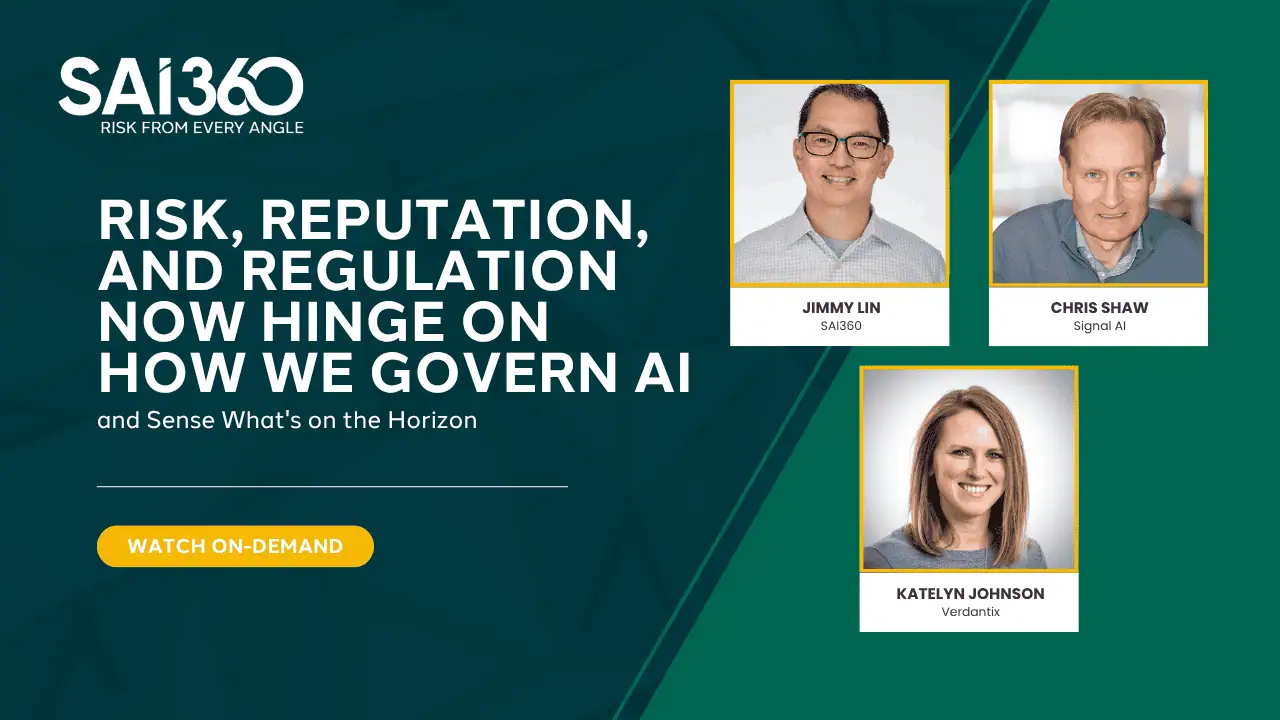
Watch the webinar, “Risk, Reputation, and Regulation Now Hinge on How We Govern AI and Sense What’s on the Horizon”, to gain practical insights and real-world strategies from industry experts.
Final Thoughts on AI Governance in Risk Management
AI is changing the nature of risk faster than traditional frameworks were built to handle. As regulatory expectations rise and external signals multiply, organizations need more than reactive controls. They need governance that connects intelligence, accountability, and decision‑making across the enterprise.
AI governance in risk management brings those elements together. By embedding governance into risk frameworks and pairing it with external intelligence, organizations can navigate complexity with greater clarity, confidence, and resilience.
The organizations that get ahead build governance into their GRC program from the start, connecting regulatory intelligence, policy, training, risk assessment and board reporting into a continuous loop. That is the difference between governance as a checkbox and governance as a capability.
Share this article
Follow us
Table of Contents