

EUDR Compliance: How to Prepare for January 2026 Reporting
If you’re a medium- or large-scale enterprise and your EU supply chain touches timber and/or forest products, you’ll need to adhere to a new EU law: the EU Deforestation Regulation (EUDR/VO 2023/1115). Proposed by the EU Commission in 2024 and serving as a replacement of the EU Timber Regulation (EUTR/EU 995/2010), EUDR requires companies to prove their in-scope products are deforestation-free.
With forests covering 30 percent of the planet’s land area and hosting 90 percent of our world’s biodiversity, deforestation, says the EU, is “one of the biggest sustainability challenges of our time.”
Did you know? Each year, the world loses another 10 million hectares (equivalent to over 10 football fields) of forest trees.
What Does the EUDR Cover?
The EUDR covers seven commodities:
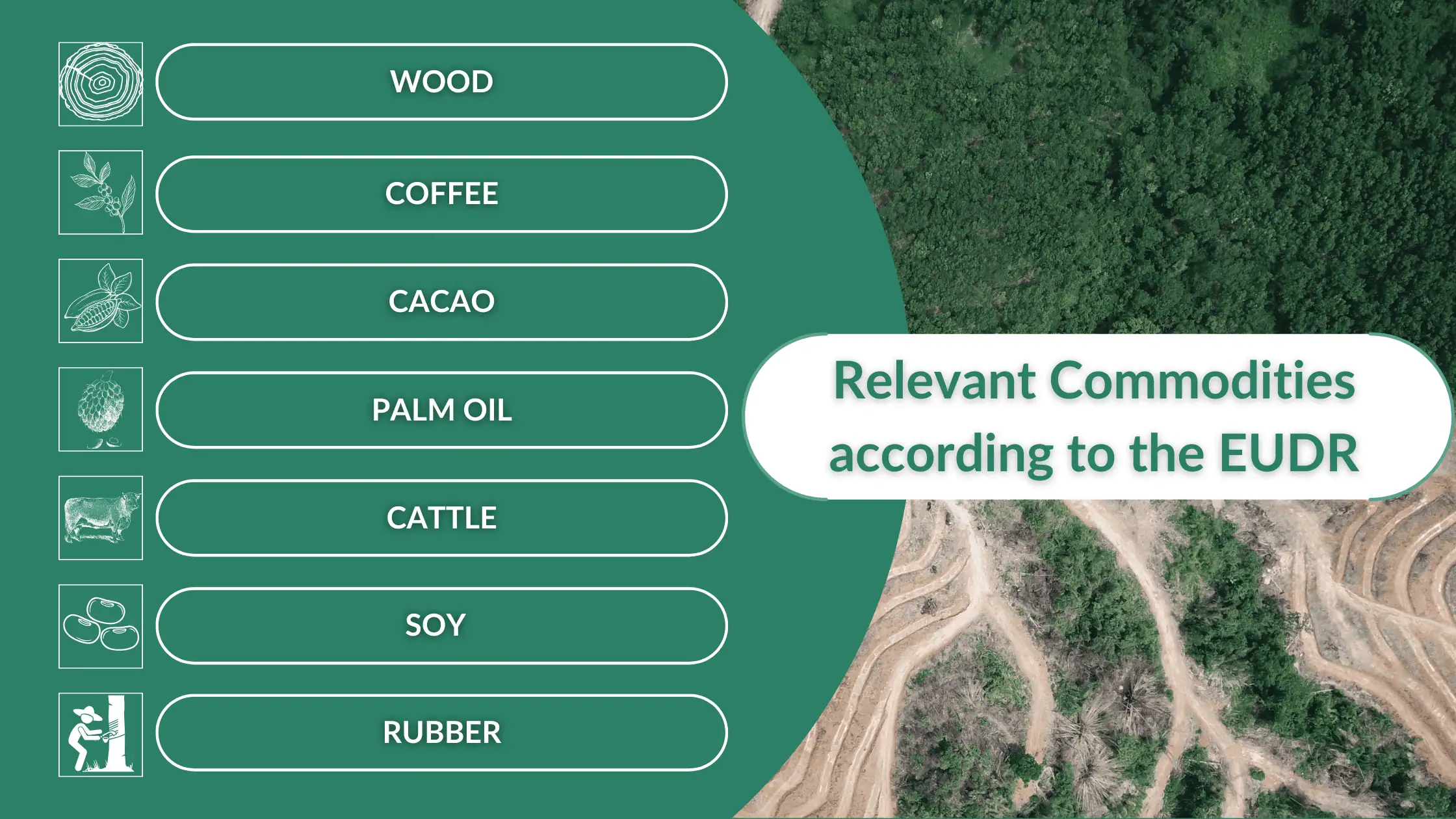
If your company uses these commodities, their components, packaging containing these components, or product derivatives, and they are imported or sold within the EU, the products must be free of deforestation via your country of origin’s specific laws.
Who needs to move fastest?
If you place products or components on the EU market, EUDR applies. That includes consumer goods, packaging, food and beverage, and manufacturing. Even if you do not buy a listed commodity directly, you may rely on it upstream. Treat this as a supply chain project, versus another legal memo.
What’s the difference between traders and market participants?
Under the EUDR, a trader is any supply-chain actor other than the operator who makes relevant products available on the EU market as part of a commercial activity. This can be for payment or free of charge and includes distribution, consumption, or use on the market.
Traders resell or distribute products without being the first to place them on the market. For example, a trader can be a company that buys a food product from an EU producer and sells it to retail chains without further processing.
Under the EUDR, the key difference is role: market participants are the first to place relevant products on the EU market or to export them (e.g., importers, manufacturers), while traders resell products already on the EU market (e.g., wholesalers, retailers) unless they themselves act as market participants.
Market participants face full due diligence duties: submit a due diligence statement for each shipment before import or export, trace product origin, collect geolocation data, and show the products are deforestation-free.
In contrast, a market participant is a company involved in the supply chain. Non-SME traders must meet similar due diligence requirements. SME traders may use certain simplifications. Correctly classifying the role (market participant vs. trader) and company size (SME or not) determines the compliance burden.
What’s the EU’s goal of creating this rule?
Guarantee products consumed by EU citizens do not worsen deforestation or forest degradation across the globe by lowering greenhouse gas emissions and mitigating biodiversity damage. And prevent commodities associated with deforestation from coming onto the EU market.
Critical to note: EUDR’s timeline has changed
The EUDR’s timeline has moved. Reporting now starts in January 2026. There is a six-month grace period for checks and enforcement regarding IT issues.
SMEs are defined as fewer than 250 employees and ≤€50 m turnover or ≤€43 m balance sheet, calculated on a consolidated group basis). That status affects obligations—e.g., SME traders get simplifications (they can rely on the market participant’s due-diligence declaration but must retain the reference number and records for five years).
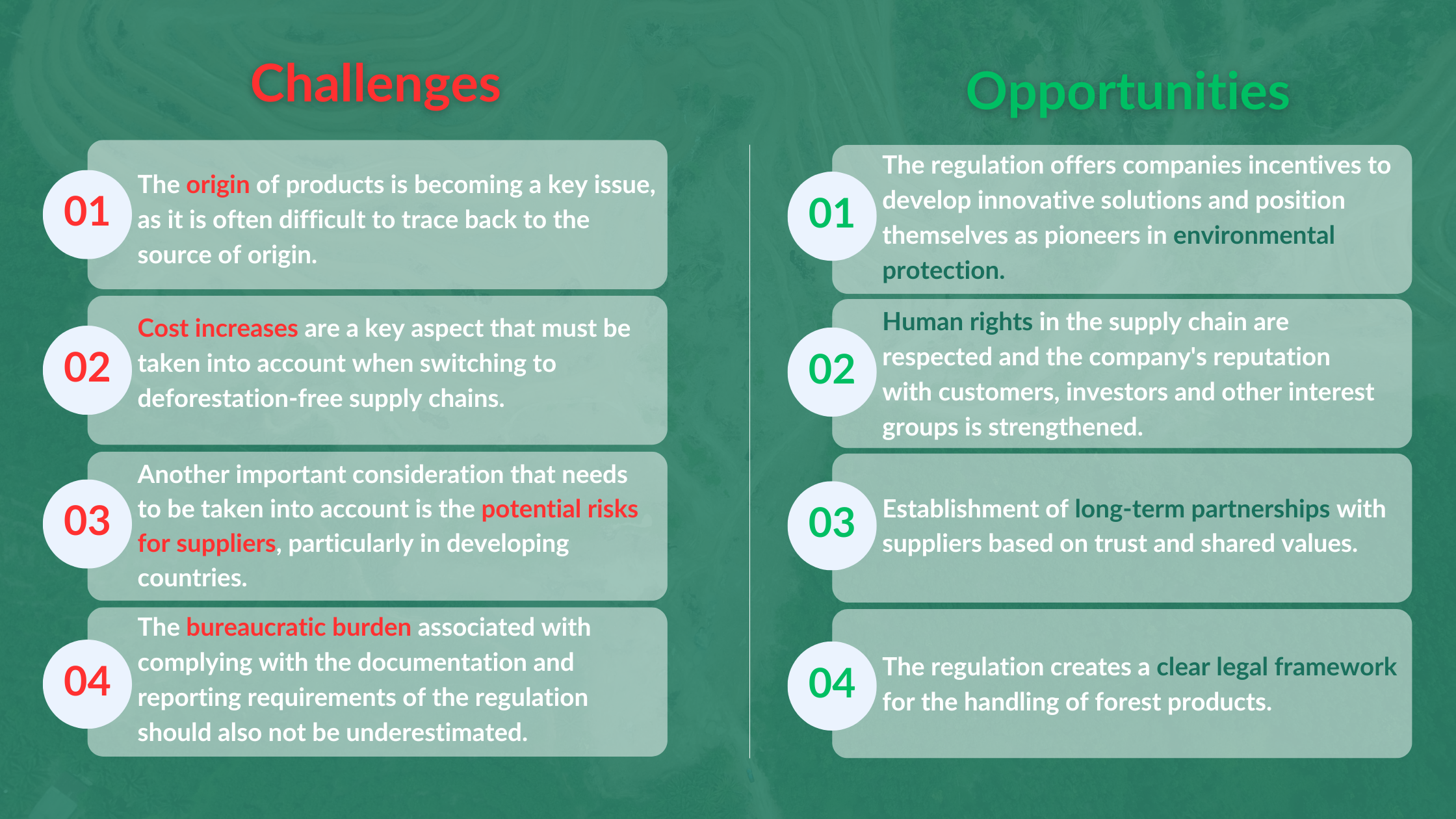
What are the key challenges and opportunities to know?
What action steps are necessary?
Here are seven suggestions:
- Run a risk analysis: Check every in-scope raw material and product against EUDR risk factors. Record what you found and what you chose to do about it.
- Prove traceability with geodata: Collect precise geolocation for cultivation areas so you can show where inputs came from and that they’re deforestation-free.
- File a due diligence declaration: Assemble origin, geolocation, and evidence in a complete DDS.
- Set a sustainable procurement policy: Write clear rules so buyers only source compliant materials.
- Respect local rules in countries of origin: Confirm social and environmental standards are met.
- Report and stay transparent: Share measures, risk results, and controls with the EU Commission. Make them public.
- Monitor suppliers and collaborate: Review performance regularly and work with authorities and partners.
Early compliance is a competitive advantage. What happens if you fail to comply?
Member states will run regular checks and audits. If you fall short, violations of EUDR can lead to fines of up to four percent annual turnover, trade bans, or product recalls.
How can SAI360 help you prepare for January 2026 EUDR compliance?
The EUDR module provides automated risk analysis across raw materials and products, guided data capture, and ready-to-use documentation. It also includes an interface to submit directly to the EU Portal. That means fewer manual steps and cleaner filings. SAI360 brings the program structure to keep everything consistent.
Taken together, you get a practical path to assess risk, collect geodata, prepare a DDS, submit, and keep records audit-ready.
Get moving now to ensure 2026 compliance
Early movers gain an edge by proving deforestation-free chains before the deadline. Early compliance is your competitive edge. We can help. With our EUDR reporting tool, prove control and publish the transparency stakeholders expect. We’ll help you automate risk analysis, standardize geodata capture, prepare the DDS, monitor suppliers, and submit to the EU Portal. This way, you can successfully manage risk—from every angle.
Share this article
Follow us
Table of Contents
- What Does the EUDR Cover?
- Who needs to move fastest?
- What’s the difference between traders and market participants?
- What’s the EU’s goal of creating this rule?
- Critical to note: EUDR’s timeline has changed
- What are the key challenges and opportunities to know?
- What action steps are necessary?
- Early compliance is a competitive advantage. What happens if you fail to comply?
- How can SAI360 help you prepare for January 2026 EUDR compliance?
- Get moving now to ensure 2026 compliance