
What to Know When Building an Operational Resilience Framework
Operational resilience is about keeping important services available during disruption. And recovering quickly when services become interrupted. It combines preparation, adaptation, response, recovery, and learning. Guidance across regions has the same unified goal: Protect customers and market integrity, all while showing clear evidence the program works in practice.
When Operational Resilience Goes Wrong, Chaos Can Ensue
There are many examples of operational resilience failures and IT downtime crises. For example, when AWS’ October 2025 outage cased by DNS resolution issues, made many online platforms unusable, cloud disruption was suddenly thrust into the spotlight. Millions of people worldwide could no longer use access AWS services, sparking over 16 million reports across 60 countries. Or, for instance, when TSB bank in the U.K. faced $60mn in fines due to a large digital transformation initiative that pulled their platform down. The result included customers seeing other people’s banking data on accident, transactions in people’s accounts that were incorrect, people not being able to pay their due balances, and bank branches having technical difficulties. Over 225,000 complaints were generated, and $40mn were paid back to customers for the inconvenience.
What does an operational framework structure allow in terms of basic components?
Think of this framework structure like an onion with many layers—ones that connect everything from initial strategy to action. Early on, you can use it to define which services matter most to customers and markets. You can set clear limits for how much disruption is acceptable. You can better map your people, processes, technology, facilities, and information. Everything that keeps your services running, including third and fourth parties. You can also test severe but plausible scenarios, improve based on what you learn, and report to leadership in clear and consistent ways.
What does this look like in terms of a structured program?
When your various steps are organized and repeatable, they form an operational resilience framework. One that people across the organization can understand and use day to day.
Where does governance fit in?
Strong governance anchors the effort. Boards and senior leaders set direction, approve resources, and make roles clear. They align resilience with broader risk appetite and ensure that oversight, audit, and challenge functions remain independent and effective. In short, leadership makes the operational resilience framework real by making responsibilities both visible and measurable. It’s a true win-win.
How do you decide what matters when building out your framework?
Identifying the most important services is critical. Start with what external users experience and work backward from there. Each service should be documented separately. This way, evidence remains clear when you classify the service and when you later test it. This is where a shared program benefits from common definitions and a consistent way to record decisions.
How do you set the limits for disruption?
Setting impact tolerances follows. Time is a common unit because it focuses teams on what must be restored quickly. Other indicators can also help, like:
- the number of customers affected,
- the scale of transactions at risk, or
- the potential for wider market impact.
Tolerances should reflect risk appetite and should be refined after exercises. Here, knowledge is power. For example, those firms that can identify which harm becomes intolerable can make faster choices during incidents.
How do you acquire a better understanding of how services work?
With mapping, which gives you the full picture of how services actually work. It should include people, processes, technology, facilities, and information. It should also include third and fourth parties.
Here, concentration risk matters. For example, many services depend on the same platform, location, or supplier—i.e. in the case of something like the October 2025 AWS outage—disruption can spark outsized effects. Scenario tests can mitigate risk as mapping can be leveraged to practice escalation paths and decision making.
Why are communications plans more than a nice-to-have?
Communications plans connect operational actions to customer trust and market confidence. Internally, teams need escalation routes and decision authorities. This way, decisions are timely and consistent with tolerances.
Externally, customers and other stakeholders need timely, accurate messages, including when direct lines are unavailable. This is because unclear or late updates can magnify harm and reputational risk.
Three ways to drive progress:
- Documentation, of course, ties all of this together
- Self-assessments explain classifications, tolerances, maps, tests, and lessons learned
- Reports help leaders see trends and act quickly
How do regional approaches compare at a high level?
Different regions use different terms, but the mechanics align closely. A small sampling is as follows:
- In the UK, supervisors built a proportionate approach around identifying important services, setting impact tolerances, mapping and testing, and robust communications and self-assessment.
- In the European Union, digital operational resilience rules bring consistent expectations for technology risk, incident handling, testing, and oversight of third-party providers.
- In Australia, prudential standards focus on critical operations and management of service providers. In Singapore, guidance on recovery objectives, dependency mapping, and concentration risk supports the broader program.
- In the United States, agencies outline governance, scenario analysis, third-party oversight, and secure, resilient information systems, together with continuous surveillance and reporting, as core building blocks.
What are the common threads across regions?
When taken together, operational resilience best practices tend to emphasize proportionality and evidence. Proportionality lets firms scale the work to their size, complexity, and risk profile. Evidence shows how choices were made and whether the program can deliver when it counts.
Where the work stalls, the causes are familiar: siloed data, uneven visibility into vendors, and inconsistent metrics. Addressing those root causes makes the whole program easier to run.
How do internal audits drive program maturity?
Internal audit assesses whether the program design is sound and whether controls are operating as expected. Independent challenges can confirm classifications are justified, tolerances are calibrated, mapping is complete, and tests are meaningful.
How can operational compliance software help?
Technology can help in clear, practical ways. For example:
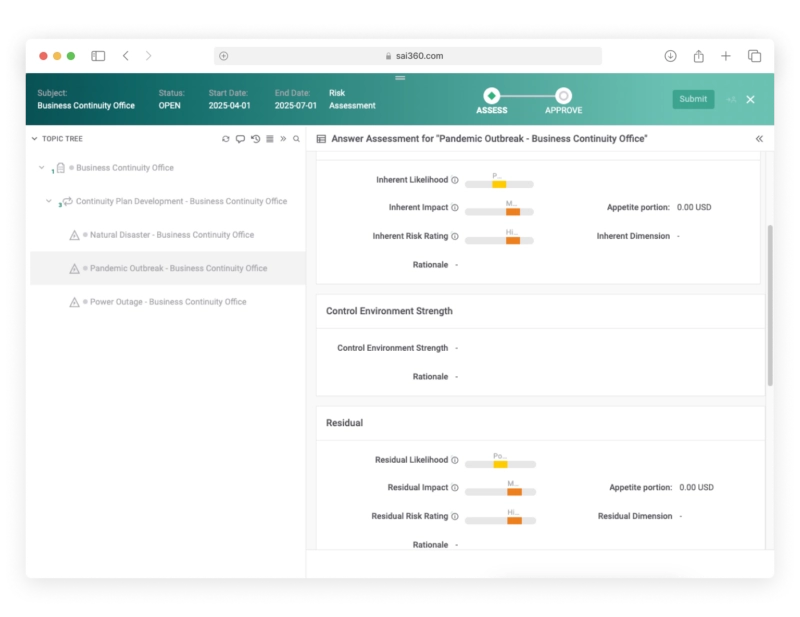
- Centralized applications allow teams to bring together information about services, risks, controls, incidents, and vendors.
- Configurable models support consistent tolerances and thresholds.
- Key risk indicators trigger notifications when limits are breached.
- Vendor records can be consolidated, screened for changes, and linked to important services. Workflow and approvals ensure actions are routed, escalated, and signed off.
- Dashboards and reports make findings visible to leadership, and self-assessment materials can be generated and updated without duplicate effort.
- Enabling planned scenarios, assigning owners, tracking remediation, and keeping a full audit trail.
Why do secure information systems matter?
Secure and resilient information systems underpin the entire effort. Programs benefit from processes to identify, protect, detect, respond, and recover. Data needs protection at rest and in transit. Backups must be created and tested. Recovery plans should consider destructive malware and other severe conditions. Architecture should reflect resilience by design and standardized tools can help assess preparedness. Surveillance and reporting keep leaders informed.
How can our organization get started?
If you’re just starting out on your operational resilience solution journey, a simple sequence of steps works well to adhere to. Namely, identify important services, set tolerances, map dependencies, run scenario tests, improve communications, and maintain evidence. Repeat this cycle regularly. And keep it proportionate to your scale and risk profile. Over time, that routine becomes part of normal operations, not a side project.
How do teams stay aligned across disciplines?
Because many teams contribute to resilience such as policy, incidents, vendor oversight, enterprise risk, internal audit, ethics and compliance training, security, and continuity planning, it helps to use a shared language. That is one reason organizations write down their operational resilience best practices and circulate them widely.
Where does business continuity fit in the bigger picture?
Plans, alternate sites, manual workarounds, and remote access keep operations moving. Resilience adds the outcome focus. Delivering the service within the limits you set and proving it with data.
How does risk management connect to day-to-day choices?
Risk management is holistic, touching every element. Teams identify exposures, test controls, monitor indicators, and update responses as threats evolve. When those activities are linked to important services and tolerances, risk management becomes more concrete for decision makers.
Why choose a clear direction for your program?
Decide what matters, decide how much disruption you can stand, understand what makes those services run, and then practice. A clear resilience strategy helps vendors and partners understand what you expect of them and how you will measure performance.
Where does technology deliver the biggest lift?
From a tooling angle, the most valuable gains come from efficiency and traceability. Data is captured once and reused many times. Evidence is organized so leaders and auditors can find it quickly. Alerts prompt action when thresholds are crossed. Reporting is standardized, so comparisons over time are easy to make. Software reduces manual effort and lowers the chance of error while improving consistency.
How should you think about the framework document itself?
Building an operational resilience framework is about making important decisions visible, tying them to tolerances and tests, and making sure evidence is easy to find. A short, clear reference reduces debate and speeds response.
What are quick regional snapshots?
Just a few to become familiar with are:
- The United Kingdom. Communications, governance, and self-assessment tie activities together so that evidence is easy to find. The approach aims to minimize harm to customers and protect the integrity of markets.
- The European Union. Digital operational resilience rules set a common baseline for technology risk across financial services. They focus on ICT governance, incident reporting, testing, and direct oversight of technology providers that deliver essential services. Although the topic is digital, the intent is broader. Keep operations going by making sure that information systems are secure and resilient and that third-party dependencies are understood and managed.
- Australia. Prudential standards concentrate on critical operations and management of service providers. Firms are expected to know what services are essential, set tolerances for disruption, and test their plans. Dependency mapping and concentration risk receive special attention, together with arrangements for alternate sites and substitution if a key provider becomes unavailable.
- Singapore. Guidance highlights critical business services and functions, recovery objectives that make sense for customers and markets, and dependency mapping across systems, infrastructure, vendors, and key personnel. Regular testing and independent audits are emphasized, along with clear roles for boards and senior management.
- The United States. Here, governance, operational processes, continuity planning, third-party oversight, scenario analysis, secure and resilient information systems, and continuous surveillance are the pillars.
What operating rhythm keeps the program healthy?
Programs benefit greatly when risk management is tightly connected to classifications and tolerances versus happening in a silo. That connection makes measures more meaningful and helps leaders see trade-offs clearly.
Building an operational resilience framework as an internal reference can reduce confusion during incidents and exercises because people know where to find the latest roles, artifacts, and procedures.
What routine helps you maintain momentum?
When it comes to operating rhythm, here’s what “great” looks like: Regular reviews update services, dependencies, indicators, and exercise plans. Post-incident lessons are tracked to closure, and routine reporting shows whether tolerances are being respected. This is where risk management helps by supplying consistent taxonomies for issues and actions. Basically, when it comes to your daily operations, business continuity provides the hands-on playbook for staying within tolerances.
Final thoughts
Buyers and owners of GRC programs need clarity, evidence, and repeatable ways of working. You want to align efforts with what global supervisors expect and what teams can run—and all without heavy overhead dragging you down. When the building blocks are simple and visible, decisions get faster and audits get easier. The result? Steadier service for customers and a program that holds up when conditions change.