Why Modern Risk Strategy Requires a Connected GRC Framework
Risk and compliance leaders often approach the same business exposure from different directions. Risk teams assess what could disrupt business objectives. Compliance teams determine which obligations apply and whether the organization can demonstrate adherence. A connected strategy brings both perspectives together.
The trouble starts when the answers live in different systems. A new regulation lands in one team’s inbox, a risk rating changes in another tool, and nobody connects the two until an auditor asks.
A connected compliance framework links regulations, obligations, policies, controls, risks, and evidence in one shared view. Instead of separate lists in separate tools, risk and compliance teams work from the same facts. Many teams call this an integrated GRC framework.
Why Do Risk and Compliance Keep Drifting Apart?
Risk teams evaluate how uncertainty could affect business objectives, while compliance teams interpret obligations and oversee the policies, controls, and evidence used to demonstrate adherence.
That split made sense when change moved slowly. It is harder to sustain now, when one regulatory update can touch policies, controls, vendors, and business units at the same time.
The split also creates duplicate work. Two teams may assess the same vendor, train staff on the same policy, or document the same control without knowing the other team did the same thing. Each team’s view is partly right, which is part of the problem. Neither has the full picture of how one regulatory change moves through the organization.
Boards and regulators increasingly ask how risks, controls, and obligations relate to each other. Answering that question is hard when the answers sit in separate systems, and it usually takes weeks of manual work to assemble.
Where Does the Gap Show Up in Daily Work?
The gap rarely shows up as one big failure. It shows up in small handoffs:
- A regulatory change is logged, but no one links it to the risk it creates.
- A risk is rated high, but the controls meant to address it sit in a different spreadsheet.
- A policy is updated, but the training and attestations never get triggered.
- An incident is closed, but its lessons never reach the obligations it touched.
None of these come from a lack of effort. They come from a lack of connection.
Each of these handoffs looks small on its own. Together, they slow decisions and leave gaps that nobody owns. A risk owner may assume compliance has the obligation covered. Compliance may assume the risk team has the exposure covered. Then an auditor asks for the link between the two, and the team builds it by hand under deadline pressure.
The real cost is not any single miss. It is the time spent reconciling information that should already agree.
What Does a Connected Compliance Framework Look Like?
A connected framework does not require every function to operate identically. It creates shared context across obligations, risks, policies, controls, evidence, and ownership.
In practice, a connected framework lets your team answer a few simple questions quickly. Which obligations does this regulation create? Which policies cover them? Which controls test those policies, and who owns each one? What evidence exists today, and when was it last reviewed? If your team can answer these in minutes rather than weeks, the framework is doing its job.
The connections also work in reverse. A control failure can point back to the risk it was meant to reduce, and to the policy and obligation behind it. That makes it easier to decide whether a fix is enough or whether the underlying requirement needs a fresh look.
How Do You Start Bridging the Gap?
You do not need to rebuild everything at once. Start with the area where a missed link would cost you the most.
- Establish a shared view of regulatory obligations, material risks, controls, and accountable owners so both teams work from consistent information.
- Trace one change end to end: a regulatory update, the policy it affects, and the evidence that proves the change was handled.
- Review the links on a set schedule, not only when an audit is coming up.
Keep the first pass small. A single pilot shows where your data lives, who owns what, and where handoffs break down. The lessons from one well-traced change usually matter more than an inventory built in isolation.
Good candidates for that first pass include areas with frequent regulatory updates, high-impact risks, or repeated audit findings. Pick one, trace it end to end, and use what you learn to decide the next area.
How Does SAI360 Support an Integrated GRC Framework?
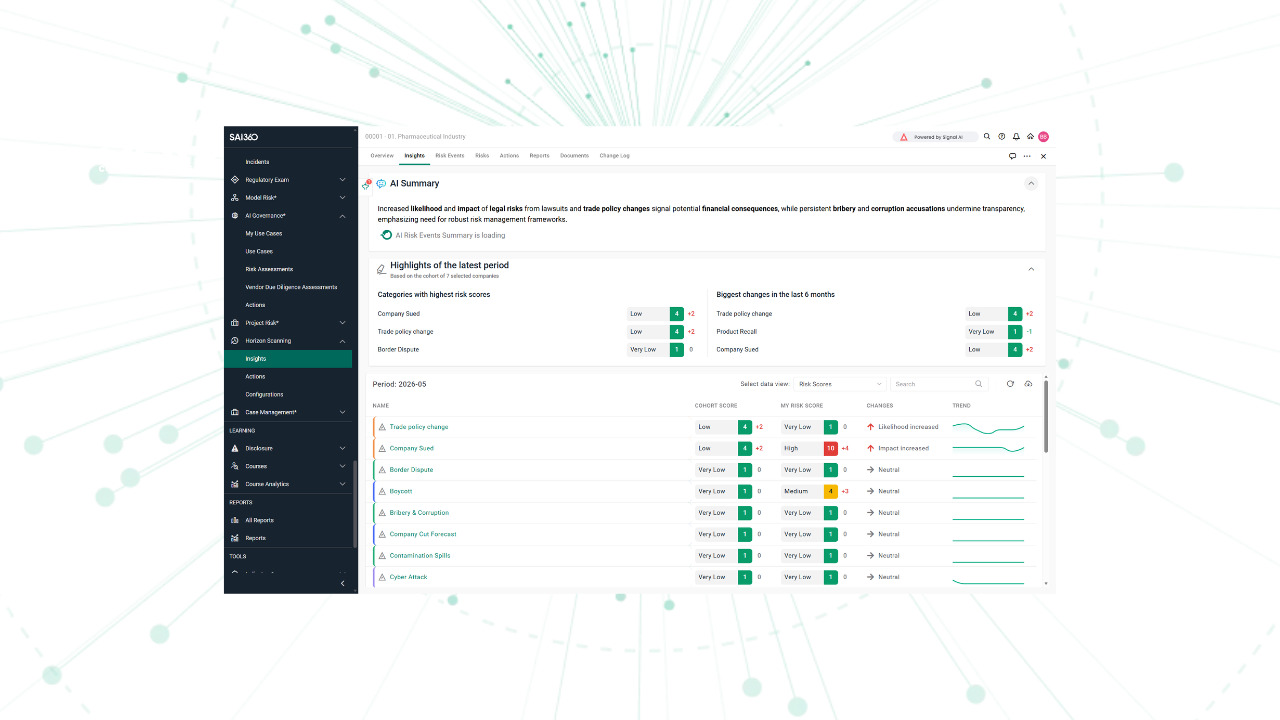
SAI360 connects regulatory changes, obligations, policies, risks, controls, evidence, and audit findings through related records on one centralized platform creating a single source of truth. When information changes in one area, teams can understand the impact across the broader risk and compliance environment.
For example, a regulatory change can be linked to the obligations it creates, the policies and controls it affects, the risks those controls address, and the evidence used to demonstrate compliance. This traceability gives risk teams greater compliance context, helps compliance teams understand the risk behind each obligation, and allows Internal Audit to follow findings through the complete governance chain.
In practice, a regulatory change can be linked to the policies it affects, the controls that test those policies, and the risks those controls manage, all in one record. Risk teams see the compliance context behind their ratings. Compliance teams see which risks sit behind their obligations. Internal audit can trace a finding back through the full chain.
That shared record is what turns a connected framework from a diagram into daily practice.
The platform’s AI supports the work without replacing judgment. It helps teams analyze regulatory content and surface what matters, while people make the final calls. You can see how this works across risk management, regulatory change, and AI across the platform.
Keep Risk and Compliance Working as One
Risk tells you where the exposure is. Compliance tells you what the rules expect. A connected framework puts both on the same page, so you can act early and keep your evidence in order.
The goal is not a perfect model on day one. It is a framework where a change in one area reliably prompts the right questions in the others, and where the answers are easy to find when someone asks. Teams that get there spend less time reconciling information and more time deciding what to do about it.
If you want to see how this looks with your own processes, request a demo. We will walk through your real workflow, not a slide deck.
Frequently Asked Questions About Connected Compliance
What Is an Integrated GRC Framework?
An integrated GRC framework manages governance, risk, and compliance as one coordinated program. Teams share data, definitions, and reporting, so each decision reflects the full picture.
How Is a Connected Compliance Framework Different From a GRC Tool?
A tool stores information. A connected framework defines how that information relates. The platform supports the framework, but the framework is the set of links, owners, and processes your teams agree on.
Why Does Risk Management Need Compliance Data?
Compliance data shows which obligations apply and whether controls are working. Risk management uses that information to decide where exposure is highest and what to address first.
Where Should a Team Start?
Start with one shared inventory of regulations and risks, then name an owner for each link between them. Expand from there, focusing on the areas where a missed connection would cost the most.
Share this article
Follow us
Table of Contents